Posture Case Study
Posture Case Study
Posture Case Study
This is a brief case study which aims to explain how we work with our clients.
In Pilates we are always trying to help our clients improve their quality of life with better movement, performed with control and a general understanding of good alignment and posture.
The client in this case is fit and well, has a desk job and enjoys being active. From time to time he experiences tension in the neck and lower back. Initiating an ongoing two-way process, together we gather information about his movements against the backdrop of his lifestyle and formulate hypotheses about the sources of his discomfort. Note, as much as we prefer clear-cut answers, it is especially common in the case of low back pain that the cause cannot be traced to any singular structural issue. In this case, we try to address any elements of the client’s movement that might be considered suboptimal. This almost invariably means improving strength (stability and control) and flexibility (mobility) in areas that need one or the other through intentional exercise.
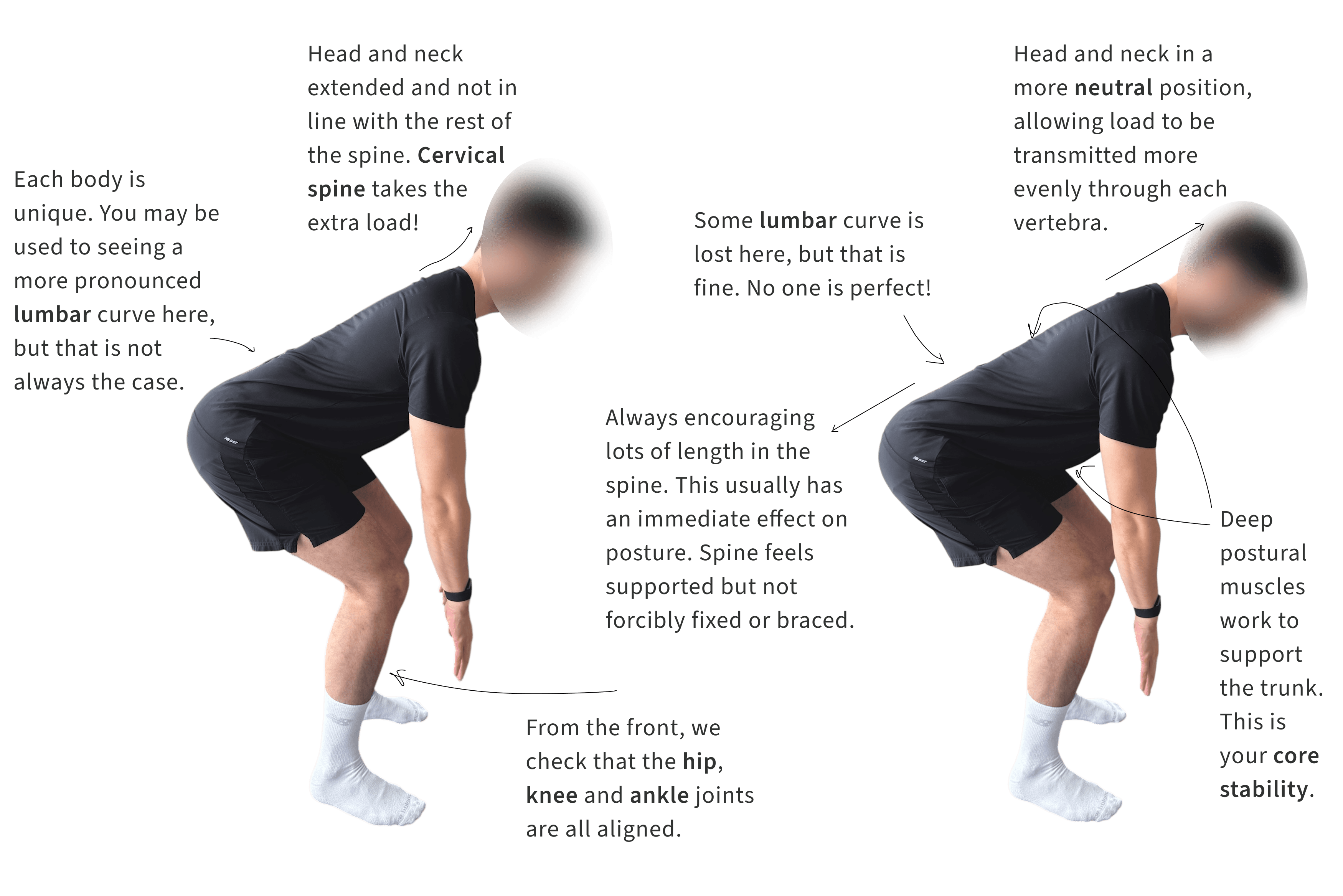
Here the client performs a Pilates squat. A simple, functional movement, but the graph illustrates some of the many considerations that factor into the quality of movement.
The figure on the left shows what the client believed to be his neutral spine. The figure on the right is closer to his actual neutral spine, corrected and reinforced through a set of 6-10 repetitions, though interestingly he had started to move out of his neutral lumbar spine by the end! Notice the subtle difference. This is completely fine, as we cannot expect to do everything correctly all of the time. It is after the session that such observations are noted down so that the exercise can be revisited.
Changes in the body take time and we must be patient. Often the same movement pattern is repeated in a different position to challenge awareness and proprioception. At the end of the day, it is down to the client to apply the principles of Pilates in his everyday life. He is encouraged to maintain awareness of his head, neck and lumbar positions when possible to avoid excess strain, taking extra care when lifting weights at the gym or sitting for long periods of time.
This is a precise approach favouring quality over quantity and concerned with the minutiae of movement, but clients should feel assured that we are careful to never insist on 'perfection', recognising that each body will have its own habits and idiosyncrasies that tell a story unique to the individual. As with any exercise, Pilates should work for you and not vice versa.
Whether you would like to improve your posture or just want to move in a way which feels good, we are here to help. Learn more about Pilates here or drop us a message.
This is a brief case study which aims to explain how we work with our clients.
In Pilates we are always trying to help our clients improve their quality of life with better movement, performed with control and a general understanding of good alignment and posture.
The client in this case is fit and well, has a desk job and enjoys being active. From time to time he experiences tension in the neck and lower back. Initiating an ongoing two-way process, together we gather information about his movements against the backdrop of his lifestyle and formulate hypotheses about the sources of his discomfort. Note, as much as we prefer clear-cut answers, it is especially common in the case of low back pain that the cause cannot be traced to any singular structural issue. In this case, we try to address any elements of the client’s movement that might be considered suboptimal. This almost invariably means improving strength (stability and control) and flexibility (mobility) in areas that need one or the other through intentional exercise.
Here the client performs a Pilates squat. A simple, functional movement, but the graph illustrates some of the many considerations that factor into the quality of movement.
The figure on the left shows what the client believed to be his neutral spine. The figure on the right is closer to his actual neutral spine, corrected and reinforced through a set of 6-10 repetitions, though interestingly he had started to move out of his neutral lumbar spine by the end! Notice the subtle difference. This is completely fine, as we cannot expect to do everything correctly all of the time. It is after the session that such observations are noted down so that the exercise can be revisited.
Changes in the body take time and we must be patient. Often the same movement pattern is repeated in a different position to challenge awareness and proprioception. At the end of the day, it is down to the client to apply the principles of Pilates in his everyday life. He is encouraged to maintain awareness of his head, neck and lumbar positions when possible to avoid excess strain, taking extra care when lifting weights at the gym or sitting for long periods of time.
This is a precise approach favouring quality over quantity and concerned with the minutiae of movement, but clients should feel assured that we are careful to never insist on 'perfection', recognising that each body will have its own habits and idiosyncrasies that tell a story unique to the individual. As with any exercise, Pilates should work for you and not vice versa.
Whether you would like to improve your posture or just want to move in a way which feels good, we are here to help. Learn more about Pilates here or drop us a message.